Why Handles Change the Way We Meet an Object
Why handles change the way we meet an object: read shape, position and material to see which gestures a design invites and how to handle it thoughtfully.
The most common mistake in reading a handle is to treat it as a neutral appendage: something to grip, rather than a form that directs the hand. That mistake hides a useful distinction between lifting, pulling, carrying and steadying. Why handles change the way we meet an object becomes plain when you notice the gestures its shape makes possible.
Why can a handle feel awkward?
Awkwardness often begins when the movement a handle suggests does not suit the object’s balance. A narrow loop may invite curled fingers, while a heavy vessel may need the palm beneath its base. The design offers one cue; the object’s weight asks for another.
Notice where your hand approaches and what the object does as you move it. A high handle can make a lift feel direct, while a low one may bring the body closer to the hip. Neither position is inherently wrong; each organises the action differently.
Say you have an invented ceramic jug with a tight, high loop and a broad, heavy body. You first lift it by the loop, then place your free hand beneath the base; the expected observable result is a steadier movement and less pressure on the fingers. That small adjustment shows how a handle can guide an action without doing all the work.
How does a handle’s position direct movement?
Position helps direct force. A drawer pull sits where a hand can draw the front towards the body; a saucepan handle extends beyond the vessel, giving the hand a place to grasp away from its sides. A tool’s handle may align with its working edge, making a push, turn or pull easier to control.
When a handle seems oddly placed, consider what must move and where the user stands. A central knob asks for a different approach from a long bar that can be grasped at several points. The bar may allow two hands to act together, but its length alone cannot establish who used the object or in what setting.
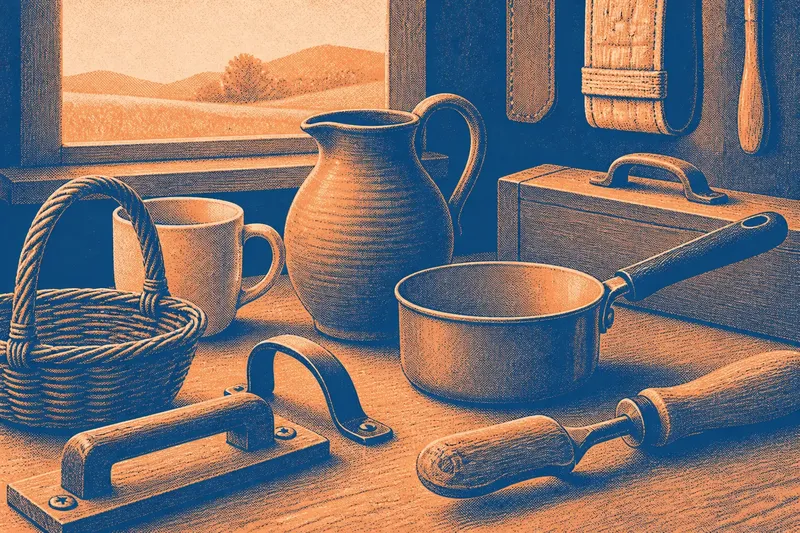
A cup handle leaves room for fingers beside the vessel; a basket handle clears the rim while supporting a load below. Each arrangement shows a design priority, not a complete account of the object’s social life.
What does the handle’s material change?
Material changes the feel of contact. Smooth wood, glazed ceramic and woven fibre each offer a different surface: warm or cool, hard or yielding, plain or textured. Those qualities affect whether a grip feels secure or delicate, and can shift as a surface becomes polished, cracked or worn.
A broad, rounded wooden grip may appear ready for repeated handling, while a slender decorated fitting may seem suited to a lighter touch. Appearance cannot establish the maker’s intention; ornament, available materials and later repairs may all shape the object we see.
When handle and body use different materials, look at their join as well as their surfaces. Screws, rivets, stitching or a change in finish can show how the parts are connected and where their functions meet. A metal fitting on a wooden body, for instance, may be placed where the design calls for a firmer attachment or a different surface.
What can an unusual handle size tell you?
Scale is easy to judge against your own hand, but the object may have been designed for a gloved grip, a cloth, two hands or use while mounted in place. A mismatch might also reflect a replacement part or a preference for compact storage.
Consider the handle alongside the object’s balance and intended movement. A small side grip on a heavy container may guide it rather than bear its full weight. A narrow grip at the end of a long implement may place the hand where it can direct a larger movement.
With an object in active use, notice where your fingers meet resistance, rather than asking only whether they fit. If a grip feels difficult to close around or encourages pinching, try a different hold or support if that is safe. Stop if discomfort persists; for a fragile or safety-critical object, ask an appropriate maker or qualified professional before altering it.
How can the handle’s traces change your reading?
Imagine an invented wooden drawer pull with a polished patch on its underside and a newer screw at one end. The visible signs are a smooth contact area and a replacement-looking fastener; one plausible reading is repeated handling followed by repair. But polishing could also come from cleaning, and the screw alone does not date the repair. The useful result is not a settled history but a set of better questions about contact and change.
For an object whose history matters, a small record can help keep those questions distinct. Write down the visible feature, the movement it might support and another explanation that fits; for example, “polished underside; perhaps frequent grasping; cleaning could also explain the sheen.” This leaves room for new evidence without turning an impression into a claim.
- Check the approach: Look for a clear path from the user’s position to the handle. If the path is unobstructed, consider a direct grasp; if not, consider whether the object is reached from another side or moved before use.
- Check the grip shape: Notice whether it accommodates a full hand, fingertips or a hooked hold. If one grip seems likely, compare it with the object’s balance; if it does not, consider that the handle may guide rather than carry.
- Check the direction of force: Identify whether the object needs lifting, pulling, turning, pushing or steadying. If the handle aligns with that movement, record it as a plausible cue; if it does not, consider a different working position.
- Check the contact surface: Look for smoothness, roughness, stains or softened edges. If wear follows a plausible grip, note repeated contact as one possibility; if it does not, consider cleaning, storage or abrasion.
- Check the attachment: Look for screws, rivets, stitching or a change in finish where handle meets body. If the join appears consistent, treat it as part of the design; if it differs, consider repair or replacement before inferring the original arrangement.
- Check for safe handling: Notice cracks, loose fittings, sharp edges or persistent discomfort. If the object feels stable and safe, proceed gently; if not, stop using it and seek suitable advice rather than modifying it casually.
What can a handle tell you, and what remains uncertain?
Does a handle show exactly how an object was used?
No. Its form can make some actions easier to imagine, but it cannot establish who used the object, how often or under what circumstances. Read it alongside the rest of the object and any reliable records available.
Why do some objects have no handle?
An object may be held by its body, moved by another part or left in place. A handle may also have been removed or lost, so its absence does not settle how the object was once handled.
Can wear show where someone held a handle?
Wear can point to places that received repeated contact, especially when a changed surface follows a plausible grip. Cleaning, abrasion and repair can produce similar traces, so compare the mark with the shape and attachment.
Should you alter an uncomfortable handle?
For an ordinary object, a different grip or separate support may make handling easier if it is safe to do so. Do not reshape a fragile, valuable or safety-critical object without suitable advice, since a small change can damage its material or construction.
What does a handle leave us noticing?
A handle places the hand, suggests a direction and sets terms for contact. To understand why handles change the way we meet an object, notice whether its form suits the movement you need or asks you to adapt. The answer may remain uncertain, but the difference between a cue and a correction is often revealing.
Next time you pick up a mug, open a drawer or lift a basket, notice whether your hand follows the handle, adjusts its grip or avoids it. That response gives you a practical way to read the design while leaving its fuller history open to question.