A Keepsake on Display or Kept Out of Sight?
A keepsake on display or kept out of sight can serve different purposes. Choose a place that suits its material, privacy and role in everyday life.
The common mistake with a keepsake is to treat a shelf as a measure of devotion: if it is not visible, it must have been forgotten. Yet a crowded mantel can make a cherished object hard to notice, while a box opened for a particular occasion can give it a distinct place in family life. The choice is less about proving attachment than deciding how the object should be used.
What does a displayed keepsake do in a room?
A keepsake on display becomes part of the room’s daily traffic. A bowl inherited from a relative might hold keys in the hall, so its former use is folded into a new routine; a photograph on a bookcase may quietly mark who belongs to the household.
But display also changes an object’s audience. A visitor may ask about it, overlook it or attach a meaning that differs from the owner’s. If the object’s story is private, a prominent position can turn a personal possession into an invitation to explain.
Consider the practical role as well as the symbolic one. An object handled often may work well on a stable, reachable surface; a fragile ornament may be safer behind a cabinet door, where it remains visible but is less exposed to knocks and curious hands.
What can a keepsake gain from being put away?
A drawer or box gives its contents a specific occasion of use: opening, choosing an object, and putting it back. That sequence can matter. A bundle of letters brought out on a family visit has a different social role from one left permanently on a table.
Private storage can also let an object remain personal without turning it into a household symbol. A ticket, pressed flower or handwritten note may be kept for the owner’s own reasons, with no need to make its significance legible to anyone else.
There is a practical drawback: objects placed out of sight can become hard to locate, and their stories can become detached from them. A labelled envelope or a short note inside a box can preserve basic context without making the object public. For delicate materials, keep care advice with the item and seek a conservator’s guidance when its condition or value makes that appropriate.
How should you decide where a keepsake belongs?
Start with the object’s intended role, then consider its material, handling and audience. Use these checks to reach a clear choice:
- Check how often you want to encounter it: if you want a passing reminder during an ordinary routine, place it where that routine happens; if you want a deliberate visit, keep it in an accessible drawer or box.
- Check whether others may handle it: if casual contact could damage it or cause discomfort, choose a closed cabinet or private storage; otherwise, a reachable display may suit it.
- Check how much of its story you want to share: if questions would be welcome, use a visible place; if you prefer not to explain, store it privately or use an unmarked container.
- Check its sensitivity to light, damp and dust: if its material or condition calls for protection, move it away from windows and damp areas or use suitable enclosed storage; if you are unsure, consult a conservator.
- Check whether you can find it again: if a stored object would be easy to lose among household items, give it a consistent place and a clear label; if the label would reveal private information, use a discreet code you can recognise.
- Check whether it earns its space in a display: if it remains noticeable and welcome where it sits, keep it there; if it blends into clutter or causes visual strain, move it to a box or another surface.
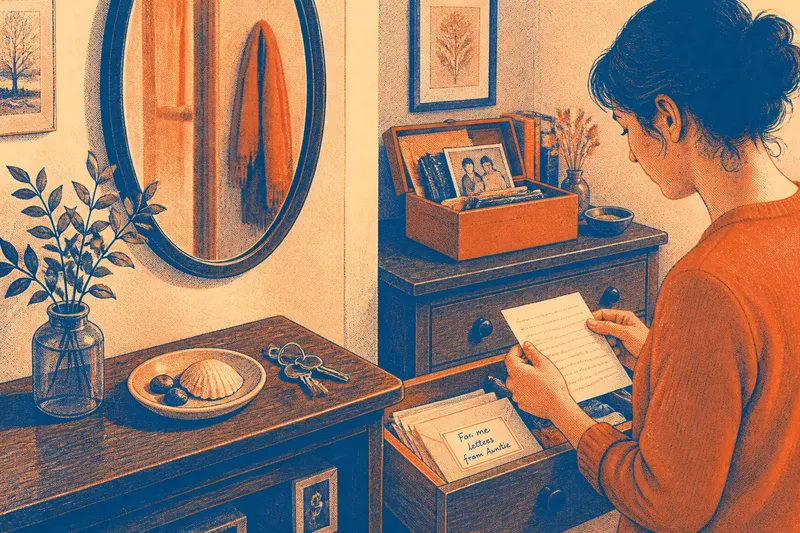
Say you have a shell from a family walk and a folded note from a relative who has died. You want the shell to prompt an occasional memory, but you do not want the note read by visitors. You place the shell in a small dish beside the hall mirror, put the note in a labelled envelope in a bedroom drawer, and write the drawer’s location on a private family list; the result is a public reminder paired with private access, though neither item is kept in a single shared display.
How can you change the arrangement without losing its meaning?
A keepsake’s place can change as a household changes. An item displayed during a family gathering might return to storage afterwards; a privately kept object might later be shared with someone who asks about its history.
When moving a keepsake, decide what the new position is meant to do. If you are putting it on view, choose a stable spot where it will not obstruct daily tasks; if you are storing it, place it in a known container and record its location in a way that respects anyone’s privacy.
Which keepsake arrangement fits your situation?
Does displaying a keepsake make it more meaningful?
No placement creates meaning by itself. Display can connect an object with daily routines, while storage can reserve it for a chosen occasion; the better fit depends on the role you want it to have.
How can you display a keepsake without making a room feel crowded?
Give it a defined place, such as a clear shelf or tray, rather than filling every spare surface. If it disappears among other belongings, move it or reduce the surrounding clutter.
How do you keep a stored keepsake from being forgotten?
Use a consistent, accessible place and a discreet label that identifies the contents or their context. If even that could disclose something private, keep a separate note in a secure place you can find.
Is a visible box a good middle ground?
It can be, if the container suits the room and protects what is inside. The box itself can occupy a visible place while its contents remain available only when you choose to open it.
For a keepsake on display or kept out of sight, the useful question is what role it can play without burdening the object or the people around it. A bowl used for keys, a note kept in a drawer and a photograph shared on a shelf belong to different household arrangements. Choose the one that fits now, and leave room for the object’s place to change as its use and audience change.