The Myth That a Souvenir Must Be a Thing
A souvenir need not be bought: use a week of small observations to keep a trip’s phrases, sketches and details without turning memory into clutter.
The common mistake is to assume a trip needs a purchased object to count as remembered. That can leave you with a shop-bought token while the detail that held your attention—a sound under an arcade, a hand-painted sign or the pause before a shopkeeper answered—has already faded. A souvenir can be a thing, but it can also be a record shaped by where you stood and what you noticed.
For a week after travelling, gather impressions while they are fresh, then choose a form that suits them. A phrase in a notebook, a rough drawing or a short account of an encounter can preserve your point of view without pretending to represent a whole place.
What can a souvenir without an object hold?
A bought object often signals a place through a name, motif or material. A written or drawn trace keeps something different: the angle from which you met that place, including a passing detail that would not fit on a souvenir-shop shelf.
A ceramic cup might recall a café in broad terms; a note about the server calling the rain “the afternoon curtain” could bring back one exchange. Neither form is more authentic by default. One gives memory a physical presence, while the other preserves a particular act of attention.
Writing suits sounds, timing and conversation. A sketch can retain the arrangement of objects on a windowsill or the outline of a street corner without needing to look polished. Even a single sentence can be enough: the blue awning lifted in the wind, and the people waiting beneath it edged closer together.
These records do not replace a trip, and they need not be art. Their value is in what makes them specific to your experience: the location, the moment and the detail that made you pause.
How can you notice without turning the trip into a task?
Choose a tool that is easy to carry and use. A pocket notebook and pencil work for brief phrases and rough marks; Apple Notes or Google Keep can capture a line when stopping to write would interrupt an encounter. One reliable tool is more useful than a collection of equipment that makes recording feel like an assignment.
At the end of the day, perhaps while waiting for a train or settling into your room, jot down details before interpreting them. Where were you? What did you hear or see? What made you pause? A plain entry is easier to revisit than an account that tries to explain an entire day.
- If you remember the wording of a phrase clearly, record it and note who said it; if not, mark it as approximate rather than presenting it as a quotation.
- If a shape or arrangement caught your eye, sketch it and add labels; if the drawing is too unclear to read later, write a short description beside it.
- If you noticed a custom, record the action and setting; if you saw it only once, keep the note about that encounter rather than treating it as a local rule.
- If a contrast stayed with you, such as a quiet square beside a busy road, describe both sides; if you cannot recall the setting, leave the contrast out until you can place it.
- If another person was part of the moment, note their role without adding details you do not know; if their identity is uncertain, describe the encounter without naming them.
- If weather or sound shaped the scene, record the condition and what it changed for you; if the sensory detail is hazy, mark it as uncertain rather than sharpening it from guesswork.
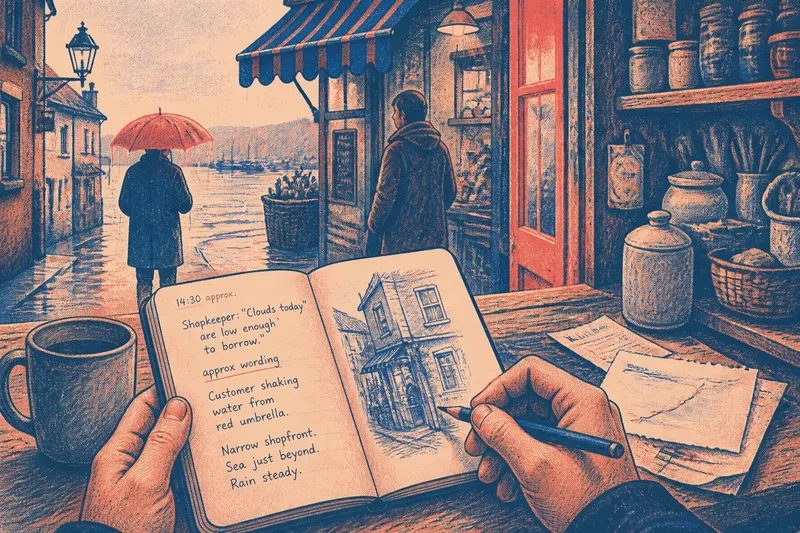
Say you spend a rainy afternoon in a coastal town and hear a shopkeeper describe the clouds as “low enough to borrow”. You write the phrase as remembered, mark it as approximate, note that a customer was shaking water from a red umbrella, and sketch the narrow shopfront. The resulting note keeps the exchange and its setting together, while the uncertainty mark prevents the wording from hardening into a claim of exact quotation.
What should you do with travel notes after you return?
On your first day home, gather scraps from pockets, notebook pages and phone notes in one place. Preserve incomplete sketches and repeated observations before sorting them; rough edges can help you distinguish one scene from another.
A day or two later, read through the material and mark details that still feel vivid. Look for a phrase that carries a voice, a drawing that recalls a route or an observation attached to an ordinary action. A queue, doorway or pause between plans may matter more to you than a famous view.
By the end of the week, choose a form for keeping what you want to revisit: copy selected entries into a dedicated notebook, fold sketches into a small sheet or collect dated notes in a digital document. Add a place and context where you know them, but do not fill gaps with details you cannot recall.
If you keep objects as well as written traces, let them sit alongside each other. A ticket may tell you where you went; a sentence can keep the way you experienced the place. The point is not to reject things, but to make room for souvenirs whose form is attention rather than purchase.
Which record suits a phrase, shape or atmosphere?
Start with the quality of the memory, not with the medium you think a traveller ought to use. These choices connect a kind of recollection to a useful way of keeping it:
- A phrase or voice: write the words, who said them if you know, and the moment around them. If the wording is uncertain, mark it as approximate.
- A shape or arrangement: make a quick drawing and label details that might otherwise be unclear. If the marks are hard to interpret, add a short written description.
- A repeated action: describe what you saw and where it happened. If it was a single encounter, keep the note limited to that scene rather than generalising about a place.
- A fleeting atmosphere: record sensory details and the conditions around them, such as rain against a window or voices carrying across a courtyard. If you cannot place the detail, mark that uncertainty.
Photographs can join this practice without having to carry it alone. A picture may show a façade while a caption records why you stopped there; that line distinguishes your encounter from the image another visitor might have made.
How can you keep a travel souvenir honest?
How do I record a phrase I cannot remember exactly?
Use quotation marks only when you are confident of the wording. Otherwise, say it was something like the phrase you remember and keep the surrounding context, so a later retelling does not make a hazy recollection seem exact.
Does a travel sketch need to look good?
No. It may only need to preserve the angle of a roof, the spacing of chairs or the position of a sign above a doorway. Add a few words if the drawing alone might not make sense later.
How can I avoid generalising from one encounter?
Keep the account attached to what you saw and where it happened. “At the bakery near the station, customers left umbrellas by the door” is more careful than treating one shop’s habit as a local rule.
What if I did not take notes while travelling?
Begin with what you can recall and mark the limits of that memory. A route, conversation or detail in a photograph may prompt a useful note, but leave uncertain gaps open rather than filling them to make the record feel complete.
When does a non-object souvenir feel complete?
A week-long routine can end with a small record rather than a finished travel diary. Keep a phrase, sketch or observation that returns you to a distinct moment, and give it enough context to remain legible later. You do not have to refine every scrap into a polished keepsake.
“A souvenir need not be bought” is most useful as an invitation to notice, not a rule against collecting. If a tangible object carries a memory you value, it can sit in the same personal archive as a pencil drawing or a line in your phone. Before your next trip, leave a blank page in your notebook or a fresh note in your app; when an unplanned detail catches you, record where you were as well as what you saw.