Before the Printed Greeting Card: How Personal Messages Took Shape
Before the printed greeting card, see how folded notes, handwriting and delivery helped a personal message suit its recipient and occasion.
The common mistake in imagining a greeting before the printed greeting card is to picture a bare note, as though personal feeling had to wait for pictures and ready-made verses. A message could take shape through its paper, folds, handwriting and delivery; overlooking those choices hides the practical ways writers addressed particular people.
What forms could a greeting take?
There was no single format for a personal greeting. A few lines might appear in a letter, on a separate note, or in a verse copied into a family book; the choice depended on the writer, recipient, occasion and available means of delivery.
A seasonal wish included in a longer letter shared that letter’s continuing voice, while a brief note sent on its own made a smaller, distinct gesture. Conventional wording did not make the act meaningless: someone still had to choose the recipient, write the message and arrange for it to arrive.
How did paper and handwriting shape a message?
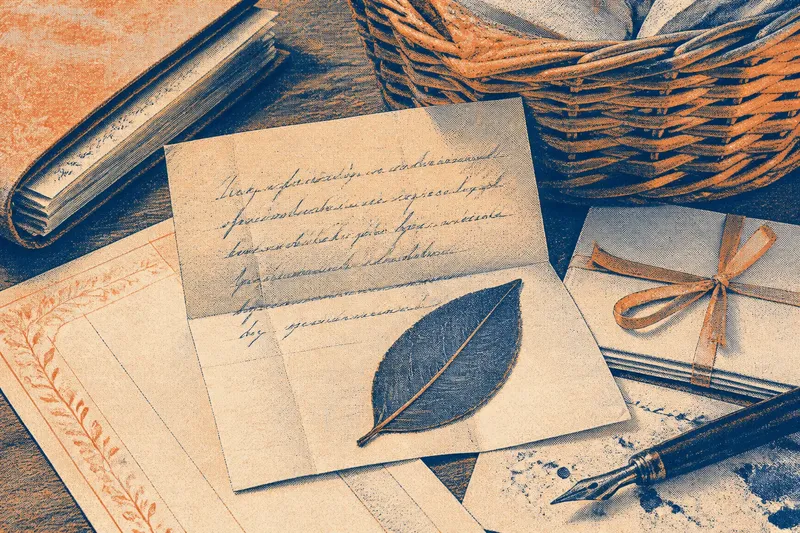
A writer could choose a clean sheet, a small scrap or paper with a coloured edge. A ruled margin, a simple drawing or a pressed leaf might give a note an occasion-specific character, though such details varied with the writer’s materials and habits.
Handwriting also affected the encounter. A familiar hand could feel intimate to its recipient; a more formal script might suit a respectful exchange. Ink blots, cramped lines and crossings-out are visible features, but their significance is uncertain without context.
Paper could be folded, enclosed or kept. A note tucked into a larger letter or passed directly between people might be discovered before it was read, making the act of opening part of the exchange.
Why did folding and delivery matter?
An open slip could be read at once; a folded sheet with an address on the outside made a small parcel. An enclosure such as a ribbon, pressed leaf or copied verse added another element, while also affecting how the message could be carried.
Delivery shaped the circumstances in which a greeting arrived. A message carried through a household, handed over during a visit or sent by post might be read in company, in private or after a delay. The writer could not fully control that setting, so format and tone had to suit the likely route.
Imagine, as an invented situation rather than a historical case, a shopkeeper named Ada who wants to send her neighbour a New Year’s wish. She has cream writing paper, a pressed bay leaf and a trusted child available to carry a basket; she writes a few lines in her usual hand, folds the leaf inside, and sends the note with the basket. The neighbour recognises Ada’s handwriting, reads the message at home and keeps the leaf in a household account book: the result is a greeting that also serves as a personal token, though its meaning depends on their relationship.
Each choice changes the exchange. If Ada had used a formal letter instead, the neighbour might have read the wish as part of a broader correspondence; if she had sent it through a busy public route, the moment of reading could have been less private.
How did printed cards change the choices?
Printed cards did not simply replace handwritten greetings. They offered a format in which an image and short message could be reproduced together, allowing senders to select a design and add a personal line rather than make the entire visual object themselves.
That altered where personal effort appeared. In a handwritten note, it might lie in the paper, script, wording and enclosure. With a printed card, the choice of image and occasion could be joined by an address, signature or added sentence.
As particular greetings became associated with occasions, familiar phrases and images could help people take part in a shared custom. A conventional message could still feel attentive through its timing, recipient and handwritten addition.
What can old greetings tell us?
A surviving message can offer clues about an exchange, but it cannot provide a complete account. A fold may show how a sheet was arranged; an address or envelope may suggest a route; handwriting and wording may indicate a degree of formality. None of those details alone establishes how the recipient felt or how common the practice was.
Separate direct observations from interpretation. Note whether the object is a loose sheet or part of a letter, whether it has a date or address, and whether decoration or an enclosure remains. Then consider possible meanings cautiously: a flourish might be playful, habitual or simply the writer’s usual signature.
Preservation affects what can be seen. A fold may have formed for carrying or for keeping, while fading may reflect handling or the writing materials. A family collection may also retain some relationships and occasions more readily than others, so one object cannot stand for every greeting.
What do readers ask about greetings before printed cards?
Did people send greetings before printed cards?
Yes. Greetings appeared in letters, short notes, verses and other written forms, with choices shaped by occasion and delivery. A message could be part of a longer letter or a separate object.
Were early greetings always handwritten?
Handwriting featured in many personal messages, but writing and decoration took varied forms. The useful question is how a message’s format addressed its recipient, rather than treating hand and print as the only distinction.
Why were greetings folded or enclosed?
Folding made a sheet easier to carry and could keep its words private until opened. An enclosure or marked fold might make receiving the message feel distinct, though its meaning depended on the people involved.
Did printed cards make greetings less personal?
Not necessarily. Printing supplied an image or phrase, while senders could personalise a card through their choice, timing, handwriting and added words. A pre-printed message might feel routine in one relationship and apt in another.
What remains personal in a greeting?
Before the printed greeting card, people used available forms to remember, acknowledge and address one another. Paper, folds, script and delivery gave even a short message a particular shape; printing later made another combination of image and words easier to circulate.
When looking at an old greeting, ask who could read it, how it might have travelled and what the sender chose to add or leave out. These practical questions keep interpretation tied to the object while leaving room for uncertainty; sometimes the clearest clue is simply a fold that protected the writing or a line addressed to one person rather than an audience.